

If there is one thing watching YouTube videos of police encounters has taught me, it’s that I’m glad I’m not a cop.
I wouldn’t have lasted a month before being shot.
I would almost certainly have hesitated if a perpetrator ignored my commands and climbed back into his car, only to come out with a loaded Glock in his hand.
Thus, I am naturally very reticent when it comes to police shootings like the one that occurred in Minneapolis recently, when an ICE officer opened fire at a woman driving an SUV in his direction.
My first reaction, when seeing the initial videos, was that the cop didn’t have to shoot the woman.
Subsequent videos were more ambiguous and made it appear that the ICE officer may have thought the woman was intending to drive straight at him when, in fact, she was making a hard right turn to get away.
It was the kind of split‑second decision that only police have to make and now, understandably, everyone has an opinion about whether the shots were justified or not.
The entire incident in Minneapolis is a tragedy and will only hurt the legitimate effort of ICE to arrest dangerous illegal aliens who should never have been allowed to enter U.S. territory under the Biden Administration’s deliberate open border policies.
But let’s see if there are any actual facts that can shed light on the matter.
The issues may help clarify things: how often police in the U.S. open fire compared to police in other countries and, even more important, how much more violent U.S. criminals are when compared to criminals in other countries.
U.S. cops may well seem trigger‑happy, but they also could have very good reasons for being so — namely, that they face a criminal underclass (yes, including female activists trying to interfere with police operations) who are far more violent, better armed, and with less respect for human life than in other countries.
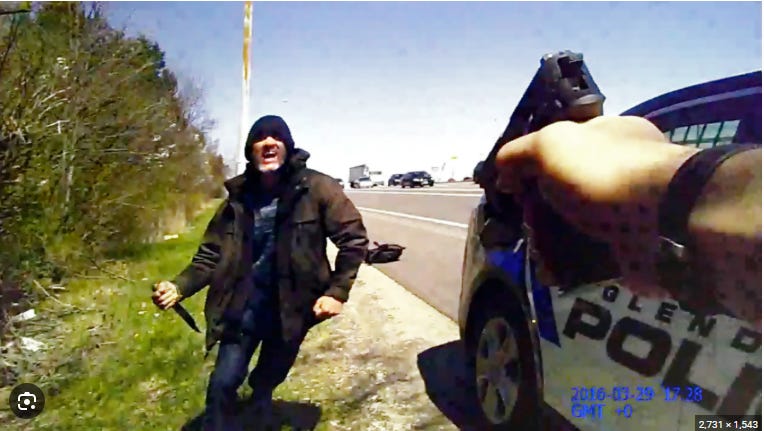
Once you start looking at comparative data, one thing becomes unavoidable: American policing does not happen in a vacuum.
In per‑capita terms, the United States is an outlier in both police killings and serious violent crime. Recent cross‑national analysis estimates that in 2019 U.S. police fatally shot people at a rate of about 3.1 per million population, roughly five times the rate in Australia and more than 22 times the rate in France.
Historical comparisons suggest that American police in 2014 were about 18 times more lethal than Danish police and 100 times more lethal than Finnish police, and still substantially more lethal than police in countries like France, Sweden, and Germany.
That’s the sort of number that fuels the narrative that U.S. cops are unusually quick on the trigger.
But then you look at the underlying crime landscape.
It turns out American gang neighborhoods are far more dangerous than the rough and tumble streets of Helsinki or Vienna.
On intentional homicide, Austria’s rate sits around 0.6–0.7 per 100,000 people, while Germany is under 1 per 100,000; the United States has been running in the 6–7 per 100,000 range in recent years.
In other words, the average American cop operates in a society where killing is roughly an order of magnitude more common than in Austria and substantially higher than in Germany.
When you widen the lens to include other serious violent crimes — armed robbery, aggravated assault, rape — U.S. rates are again several times higher than those typical in Western Europe.
A U.S. Bureau of Justice Statistics international comparison found that crimes of violence such as homicide, rape, and robbery are four to nine times more frequent in the United States than in Europe.
And crucially, U.S. violence is much more heavily weaponized: firearms are used in roughly two‑thirds of American murders and a substantial share of robberies, far more than in most European states.
What that means on the street is that an American patrol officer is simply more likely to confront an assailant who is armed, desperate, and prepared to use lethal force. That environment plausibly explains part of the gap in police shootings.
A high rate of gun homicide is extremely strongly correlated with a high rate of fatal police violence; one comparative study found a 0.97 correlation between gun homicide rates and police killings across 18 countries.
In that framework, U.S. officers don’t just “decide” to be more lethal — they are operating in a setting where the background level of lethal threat is much higher.
At the same time, the police‑lethality gap is bigger than the crime gap alone.
Even when you compare the United States to other countries with armed police and some level of civilian gun ownership, such as Germany or Austria, the U.S. still stands out.
German officers are routinely armed, but firearms are discharged at people only a few dozen times a year, with around a dozen fatalities nationwide, in a country of more than 80 million.
Austrian police also carry guns, and yet fatal shootings are rare enough that some years go by with no one killed by police gunfire at all.
These are hardly pacifist societies, but the combination of tighter gun laws, different tactics, more restrictive legal standards and a far more peaceful, homogenous society seems to keep lethal encounters down.
When you pull all of this together, the YouTube clip of the ICE officer and the SUV stops looking like an isolated moral drama and more like a node in a larger social tragedy that regular officers have to confront on a daily basis.
On one level you have a human being making a split‑second judgment about whether a metal box hurtling toward him is a weapon; on another you have a country where violent offenders are more heavily armed and more lethal than in most peer democracies, and where the line between justified fear and overreaction gets crossed more often than anyone would like.
That doesn’t tell you, by itself, whether the Minneapolis shots were justified.
But it does suggest that if you want to understand why American cops seem more willing to fire than their Austrian or German counterparts, any honest accounting has to take into account the different worlds these officers are policing — and the fact that U.S. police face a criminal ecosystem that is far more dangerous than that faced by their European counterparts.

Robert J. Hutchinson is the author of numerous books of popular history, including Searching for Jesus: New Discoveries in the Quest for Jesus of Nazareth (Thomas Nelson), The Dawn of Christianity (Thomas Nelson), The Politically Incorrect Guide to the Bible (Regnery) and When in Rome: A Journal of Life in Vatican City (Doubleday). Email him at: roberthutchinson@substack.com