

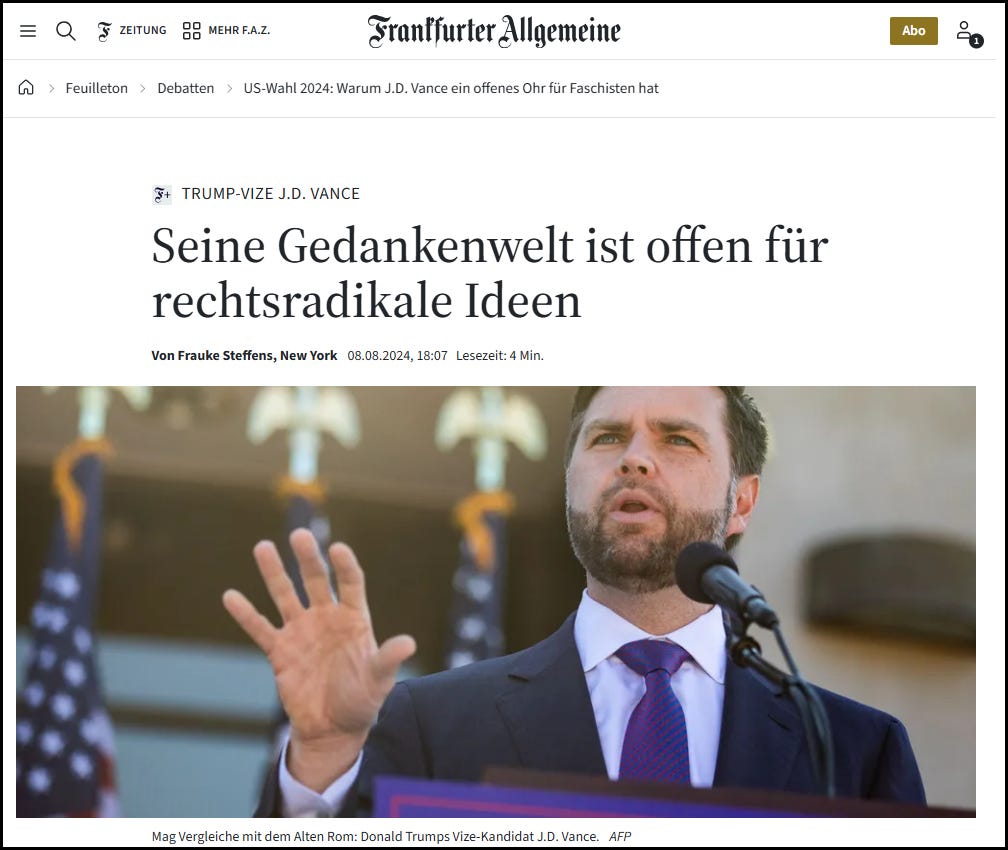
Many publications in Europe portray U.S. Vice President J.D. Vance as sympathetic to “radical right ideas” such as integralism.
Thank you for reading! Disputed Questions is dedicated to exploring the questions that divide us with logic, fairness and, we hope, some humor. To receive new posts, consider becoming a free or paid subscriber.
I would like to propose a solution to the moral panic over “integralism,” the obscure Catholic political philosophy that says the State should, at least under certain circumstances, follow the teachings of the Catholic Church.
I call this a moral panic because the political alarm is wildly disproportinate to the movement’s tiny constituency.
Writing in 2020, even one of its chief critics observed that, apart from three prominent figures, integralists “largely keep to personal blogs and Twitter accounts.”
In Europe especially, integralism often seems a rhetorical bogeyman used by bureaucrats, politicians and the media to frighten citizens into voting for governing parties and coalitions that are now wildly unpopular with their constituents.
In the U.S., some conservative podcasters such as Daily Wire co-founder and outspoken Trump critic Jeremy Boreing has promoted the controversy by questioning whether integralism is “a Catholic plot to overthrow America.”
What nonsense.
What Are We Actually Arguing About?
The truth is, integralism is an obscure, serious, but quite small intellectual movement within conservative Catholic circles to examine the presuppositions of philosophical liberalism – the U.S. Founding as well as the teachings of such philosophers as John Locke and John Stuart Mill – to see if they are compatible with the teachings of the Catholic Church.
The short answer is that, taken in their more extreme libertarian forms – in which there are few if any moral facts and everyone is free to do whatever they wish with their own bodies -- they are not.
In their more moderate forms, which helped give birth to such institutions as the separation of powers, religious freedom, democratic legislatures and so on, they are.
The Second Vatican Council, in its landmark 1965 declaration Dignitatis humanae, the Declaration on Religious Freedom, recognized this.
Yet it grounded its acceptance of religious liberty in human dignity rather than religious indifferentism and explicitly allowed special constitutional recognition of state religions, provided that religious freedom and equality before the law were protected for all.
At the moment, the debate over integralism is of course framed in apocalyptic political terms.
The political theorist James M. Patterson is on the podcast circuit – such as Jeremy Boreing’s – portraying contemporary neo-integralism, including the work of Notre Dame scholar Patrick Deneen and Harvard law professor Adrian Vermeule, as a revival of authoritarian Catholic politics.
His entertaining and very informative book, Why Postliberalism Failed (2026), written with Thomas D. Howes, is worth reading as an overview of the dispute.
Moral Truth Is Not Theocracy
To clear away the smoke of the battle, I propose making some distinctions – for example, between what we might call “moral integralism” and “religious integralism.”
The first states that there are some fundamental moral truths that the state can and must recognize, even “liberal” democratic states that claim to be “neutral” on all religious questions.
The second asserts that states also should recognize religious realities – for example, as the State of Israel does when it says Israel is officially a “Jewish” state and insists the Jewish marriages performed in Israel must be performed by designated Orthodox rabbis to be recognized by the state.
I also propose distinguishing “extreme” integralism from what I like to call “moderate” or even “light” integralism.
The philosopher Edward Feser does something similar, distinguishing “soft,” “moderate,” and “hard” integralism and insisting that asking whether someone supports integralism is unhelpful without disambiguation.
Integralism in its stricter Catholic sense argues for the goal of creating of Catholic confessional states in which the temporal authority is subordinate, in matters bearing on humanity’s ultimate end, to the spiritual authority of the Church.
Yet that is not the same as recognizing established religions and the moral assumptions held by the majority of citizens. I propose calling the latter “light” or “moderate” integralism, while acknowledging that this extends the term beyond its usual Catholic meaning.
Many people of good will – not a fascist or neo-Nazi among them! – have no objection to Denmark’s established Evangelical Lutheran Church, to which most of the population belongs, provided the rights of religious minorities are protected.
Other people of good will – also not fascists – think that the State can and must recognize certain basic moral truths, among these the right to life. Such a principle can even be found in the U.S. Declaration of Independence.
The Liberal State Takes Sides
Part of integralism’s contemporary appeal, I would argue, comes from frustration with progressive claims – in the Democratic Party in the U.S. and in various far-left political parties in Europe – that moral considerations should have little, if anything, to do with practical politics.
Many left-wing parties claim that any limitations on people’s free choices – such as with abortion up to the moment of birth, physician-assisted medical killing, or even polygamy – is “intolerance,” “anti-democratic,” and a regression into a fascist state.
Many voters in the U.S., at least, disagree.
Instead, millions woke up one day and realized that the liberal state, far from being “neutral” on important moral issues, such as gay marriage or euthanasia, had taken sides against the majority of the population.
Under the Obama and Biden administrations, Americans discovered that government organizations were advancing the “trans” agenda using the force of law – and that parents who objected to some policies were being prosecuted and, in some cases, even had their children taken from them.
A Republic, Not a Confessional State
Despite this, I think Patterson and other critics of “integralism” are largely correct.
The American Catholic tradition of reconciling religious conviction with republican government offers a better starting point.
What Patterson calls the “Catholic Republicanism” pioneered in the U.S. by such figures as John and Charles Carroll, John Hughes, John Ireland, Fulton Sheen, and John Courtney Murray, is more than adequate to overcome the latent authoritarianism within many liberal political parties.
We don’t need a Catholic confessional state to oppose Democratic-backed laws that would force Catholic hospitals and religious caregivers to facilitate physician-assisted suicide.
Yet I also don’t think the State of Israel, in having a “light” integralism that recognizes the moral and religious character of the Jewish state, is being unjust in doing so.
So is integralism compatible with republican government and democratic norms?
The answer depends on what we mean by integralism.
Public recognition of fundamental moral truths (“we hold these truths to be self-evident”) or a majority religious tradition is not the same as giving ecclesiastical authorities coercive political power.
If critics want to challenge the latter, they should do so directly—not treat every public moral judgment as a step toward fascism.
What I have called “light integralism” can coexist with democratic government.
More demanding forms, which have no clear Christian examples outside the Vatican itself, raise different questions about religious liberty and political authority.
It is intellectually dishonest to discuss them as though those differences don’t matter.
Spread the Word
At Disputed Questions, we examine the questions that divide us—in the Church and the world. We look behind the news to explore competing claims about faith, morality, politics, science, and human dignity: where those claims come from, what supports them, and what follows if they are true.
The purpose is understanding.
That requires checking sources, considering historical context, presenting opposing arguments fairly, and making judgments the evidence can support. It also means acknowledging when a question remains unresolved.
You do not have to share our beliefs—or agree with our conclusions—to find a place here. We welcome readers who believe that difficult questions deserve serious examination and that disagreement is an occasion to think more carefully.
If you value this work, there are three straightforward ways to support it:
Subscribe to Disputed Questions. A free subscription brings future columns to your inbox. A paid subscription helps sustain the research and writing behind them.
Share this Post. Share this post (and Disputed Questions) with a friend who might enjoy it —or offer a thoughtful objection to the answer.
Support Disputed Questions. This fuels this project’s mission.
Whether you subscribe free or contribute financially, thank you for reading. Our commitment is to give each question a fair hearing, explain how we reach our conclusions, and remain willing to reconsider them.

Robert J. Hutchinson is the author of When in Rome and Searching for Jesus. His forthcoming book, Two Leos: The Popes, Technology, and the Struggle for Humanity’s Future, examining the parallel pontificates of Leo XIII and Leo XIV, will be published by Angelico Press in 2027.