

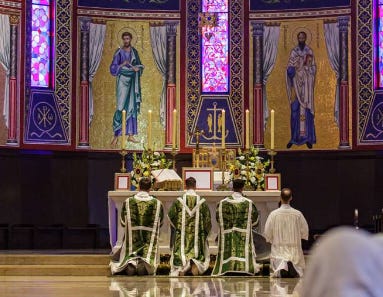
At St. Michael’s Abbey in Orange County, California, the Norbertines have quietly begun celebrating Mass ad orientem, with the priests facing away from the people during the Eucharistic Prayer.
Thank you for reading! Disputed Questions is dedicated to exploring the questions that divide us with logic, fairness and, we hope, some humor. To receive new posts, consider becoming a free or paid subscriber.
Once a month, I like to drive out to Silverado Canyon for the conventual mass at St. Michael’s Abbey, the stunning new $120 million monastery dedicated by the Norbertines in 2021.
It’s a 40 minute drive each way but well worth it.
The Norbertines, like the traditionalist-oriented Oratory in London, avoided the recent Vatican crackdown on the Latin Mass that began under Pope Francis with his Traditiones Custodes.
Both the Norbertines and the Oratory celebrate the Novus Ordo mass of Vatican II but entirely in Latin... with Gregorian chant, incense, and elaborate monk-like rubrics.
But there was one way the Norbertine Mass used to look just like the one I usually attend: the priest always faced the people, versus populum as they say.
But now, that has changed.
Last Sunday, I was surprised to see the priest facing ad orientem, toward the East and toward the tabernacle, his back to the people.
I don’t know if this is due to the election of a new abbot, but in August the Norbertines announced (there was a notice in the back of the church) they were making the change.
As anyone knows who has followed the liturgy wars over the past 50 years, this was the practice of the Church for nearly its entire history – and still is for Eastern Orthodox and Eastern Catholic churches.
When you visit ancient churches in Israel, the Middle East, Italy and even France, you can see how they were configured.
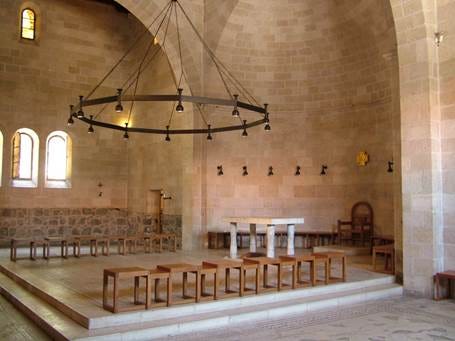
In the Church of the Primacy of St. Peter, Tabgha, on the Sea of Galilee, the free-standing stone altar sits at the top of the apse with the episcopal cathedra and synthronon behind (Source: Robert Hutchinson).
In general, there was a semi-circular apse at the top of the nave, with benches (the synthronon) going around where the clergy sat. Between the apse and the nave was found a free-standing stone altar that clergy could walk around, sometimes covered by a ciborium (or roof) on columns.
In this, at least, the reformers of Vatican II were indeed returning to the practice of the ancient church by having free-standing altars, not shelves attached to a wall.
But unlike today, in these ancient churches the priest celebrating mass faced his fellow priests in the apse, with his back towards the people in the nave of the church.
All were facing East, towards Jerusalem and God, with the priest “leading” the people as they re-presented the sacrifice of Calvary.
So where did the versus populum idea come from?
I used to think, influenced by my Trad relatives and friends, that versus populum was a Protestant innovation (Martin Luther did propose it) but apparently that isn’t the case.
After the Reformation, the Lutheran churches continued to conduct their services in the old way for centuries, with the ministers facing away from the people. Anglican churches did the same.
In a word: the notion that the priest should face the people was mostly an innovation pushed by liturgical experts in the 1960s... one that many Protestant churches later copied rather than initiated.
Vatican II’s official document on the liturgy, Sacrosanctum Concilium (1963), makes no mention of “turning the altars around,” but later post-conciliar documents, such as Inter Oecumenici (1964), do.
What’s more, the official General Instruction of the Roman Missal (GIRM), explicitly states that the altar should be built separate from the wall so that Mass can be celebrated facing the people, “which is desirable wherever possible.”
Personally, I’m neutral on the issue.
My family has been lucky by always being members of sane parishes that celebrated the Novus Ordo mass with reverence.
What’s more, last year visiting the Vatican I was struck by the simplicity and dignity of daily Mass there, with an Italian priest standing at a simple altar and celebrating Mass with minimal fuss.
And yet, I can’t deny that I find the change at St. Michael’s Abbey to be an improvement.
It seems like a return to what the Church has always done.
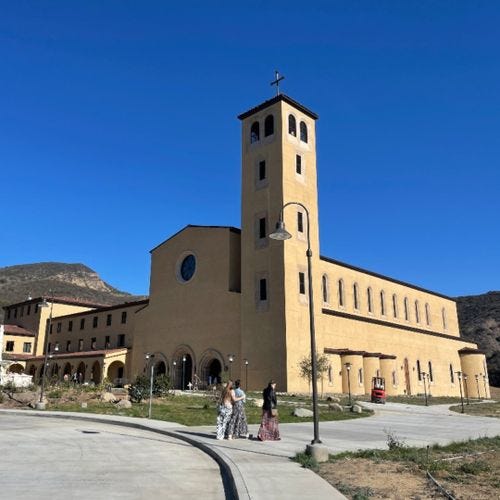
St. Michael’s Abbey in Silverado Canyon, California, opened in 2021 with a reported cost of $120 million.
Celebrating Mass in Latin but facing the people seems like an awkward hybrid, even though, due to the way St. Peter’s Basilica in Rome was constructed, this is how Mass was celebrated at the papal altar in the Vatican for centuries.
Also, the Novus Ordo Latin Mass does not have a silent canon. At St. Michael’s, the celebrant has a mic and you can hear the entire Eucharistic Prayer, which I like. The same is true at the Oratory in London.
So, I think what’s happening is this.
The Vatican seems determined to suppress or at least discourage traditionalist groups that oppose Vatican II, such as the Society of St. Pius X... yet it also recognizes that many young people especially are attracted to the reverence and mystery of the traditional Latin mass.
As a result, there is a movement to return to the Novus Ordo liturgy those elements that many people find meaningful, such as Latin (at least in parts), incense, kneeling for communion, and even the ad orientem orientation.
At the same time, they are keeping an audible canon (in the TLM the canon was silent, whispered by the priest), more streamed lined prayers, and the updated three-year cycle of lectionary readings.
In a nutshell, the “reform of the reform” championed by Pope Benedict XVI is basically under way right now.
I doubt the whole Church will ever go back to the pure TLM of the SSPX, with lace and birettas and the silent canon.
But it will be much more traditional, more like what the Eastern Churches do now, more in keeping with 1,800 years of liturgical history.
If you want to see the future, visit St. Michael’s Abbey.
Spread the Word
At Disputed Questions, we examine the questions that divide us—in the Church and the world. We look behind the news to explore competing claims about faith, morality, politics, science, and human dignity: where those claims come from, what supports them, and what follows if they are true.
The purpose is understanding.
That requires checking sources, considering historical context, presenting opposing arguments fairly, and making judgments the evidence can support. It also means acknowledging when a question remains unresolved.
You do not have to share our beliefs—or agree with our conclusions—to find a place here. We welcome readers who believe that difficult questions deserve serious examination and that disagreement is an occasion to think more carefully.
If you value this work, there are three straightforward ways to support it:
Subscribe to Disputed Questions. A free subscription brings future columns to your inbox. A paid subscription helps sustain the research and writing behind them.
Share this Post. Share this post (and Disputed Questions) with a friend who might enjoy it —or offer a thoughtful objection to the answer.
Support Disputed Questions. This fuels this project’s mission.
Whether you subscribe free or contribute financially, thank you for reading. Our commitment is to give each question a fair hearing, explain how we reach our conclusions, and remain willing to reconsider them.

Robert J. Hutchinson is the author of When in Rome and Searching for Jesus. His forthcoming book, Two Leos: The Popes, Technology, and the Struggle for Humanity’s Future, examining the parallel pontificates of Leo XIII and Leo XIV, will be published by Angelico Press in 2027.