

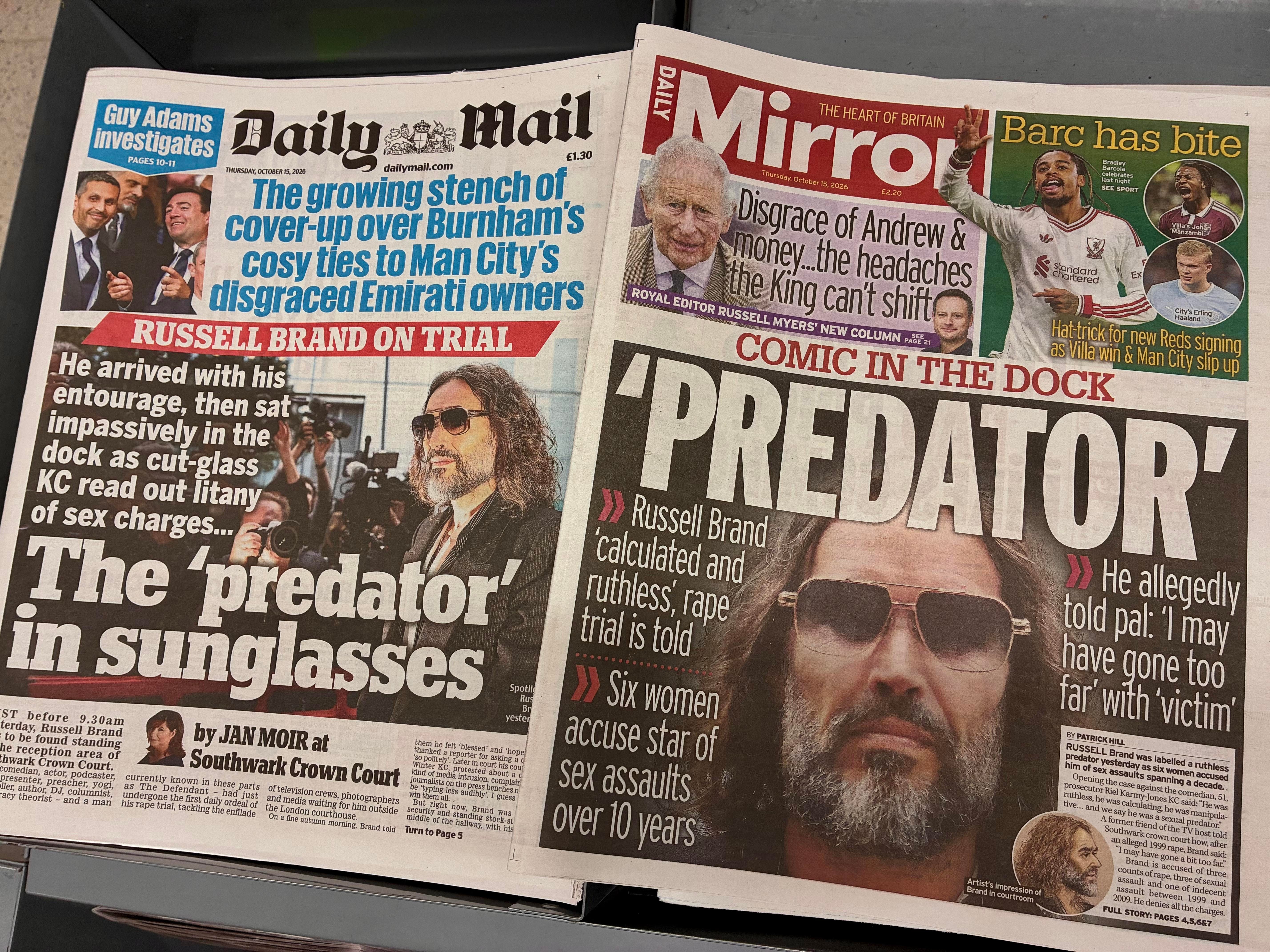
Actor and political commentator Russell Brand was convicted of a rape that was alleged to have occurred 17 years ago, following the broadcast of a TV documentary entitled, “Russell Brand: In Plain Sight,” which aired September 16, 2023 (Source: Shutterstock).
Thank you for reading! Disputed Questions is dedicated to exploring the questions that divide us with logic, fairness and, we hope, some humor. To receive new posts, consider becoming a free or paid subscriber.
The Hollywood actor and YouTube personality Russell Brand was recently convicted, at first in a trial by media and then in an actual court of law, of raping a woman 17 years ago (in 2009).
The woman testified that during consensual sex Brand engaged in a particular sex act against her will, ignoring her pleas to stop.
This is the polite way of putting it. The actual reality, as the woman described it, was bloody and brutal.
For this, Brand was sentenced to nine years in prison.
Brand received an additional combined 18 months for three other convictions of sexual assault – groping women in two cases – arising from incidents in 2004, 2004 or 2005, and 2009.
The allegations reached police much later. The women involved only went to the police in 2023 or 2024, following a TV documentary entitled, “Russell Brand: In Plain Sight,” broadcast September 16, 2023.
Even though many concede Brand is or was a celebrity sex fiend who likely used his fame to bed hundreds of groupies, some find his conviction for a crime nearly 20 years after the fact to be troubling.
The case also highlights one of the primary differences between the legal systems in the UK and the U.S.
In the U.S., there are statutes of limitation which reflect the commonsense assumption that it is unjust to charge people with crimes that are alleged to have occurred in the distant past.
That’s because it’s difficult to prove such crimes occurred beyond a reasonable doubt with the passage of time, the deterioration of human memories, the lack of physical evidence or corroborating testimony, and more.
As early as 1790, the first U.S. Congress imposed prosecution deadlines in its first major federal criminal statute.
Most capital offenses had a three-year limitation period. Noncapital offenses had a two-year limitation period. (Murder was the exception.)
No Lapse of Time Bars the King
The governing principle is the longstanding common-law rule that nullum tempus occurrit regi —“no lapse of time bars the king.”
But the U.S. has no king.
If a woman comes forward in the U.K. and says Joe Smith groped her in a pub in 1976, or 50 years ago, the person in question could be charged and convicted under British law, even if the only evidence is the complainant’s testimony.
But not in the U.S.
In the United States, a 50-year-old allegation of groping (ordinary non-penetrative sexual touching of an adult, typically charged as misdemeanor sexual battery, sexual abuse, or indecent assault) would be time-barred in every state.
As recently as 2015, 34 American states imposed time limits even on felony sexual-assault prosecutions, according to the BBC.
However, following the revelations in the early 2000s of sexual abuse of boys by male priests in the Catholic Church, many states eliminated time limits for offenses against children and then, after the Me Too movement, for sexual offenses against women.
California, for instance, abolished its previous 10-year limit for many sex offenses in 2016, prompted in part by the notorious case of TV actor Bill Cosby.
However, some Americans are already having second thoughts about this change.
That’s because we’ve witnessed what happens when society replaces the doctrine of “believe all evidence” with the very different doctrine of “believe all women.”
U.S. Supreme Court Justice Brett Kavanaugh almost had his nomination derailed when a woman came forward, escorted by Democratic members of Congress, and claimed to have a memory “indelible in the hippocampus” that Kavanaugh groped her and tried to get her clothes off during a high school party in 1982... approximately 36 years before she testified.
Although the Kavanaugh case was not a trial, this was why statutes of limitation were invented.
Witnesses die, memories fade, and potentially exonerating records disappear.
Decades after an alleged offense, an accused person may be unable to reconstruct where they were, identify witnesses, or recover documents that would have answered the allegation when it was fresh.
Rights of the Accused
This is one of the central reasons for statutes of limitations: protecting defendants from charges they can no longer meaningfully contest.
Such deadlines can also serve as a check on “lawfare,” the use of legal proceedings to pursue political opponents or advance personal careers.
In New York State, a Democratic-controlled legislature and Democratic governor enacted a temporary law creating a one-year window to revive otherwise time-barred civil sexual-abuse claims.
That law enabled a woman to sue Donald Trump over an alleged sexual assault nearly three decades earlier, an incident she described in a book.
What’s more, contrary to claims that all women must be believed under all circumstances, the evidence shows women can and do lie, even about rape.
In the UK, a pretty young woman named Eleanor Williams falsely accused numerous men of rape and claimed she had been sexually trafficked. She even posted photographs of facial injuries that she attributed to her supposed attackers.
CCTV footage and digital evidence revealed she was lying, even that she had purchased a hammer to inflict injuries on herself. She was sentenced to an eight-and-a-half year prison sentence for perverting the course of justice.
So, two things can be true at once.
Russell Brand could be a sexual predator who deserves punishment.
And America’s early embrace of prosecution deadlines reflects a principle worth preserving.
The state’s power to prosecute should be constrained not only by the seriousness of an accusation, but also by the accused’s continuing ability to answer it.
Spread the Word
At Disputed Questions, we examine the questions that divide us—in the Church and the world. We look behind the news to explore competing claims about faith, morality, politics, science, and human dignity: where those claims come from, what supports them, and what follows if they are true.
The purpose is understanding.
That requires checking sources, considering historical context, presenting opposing arguments fairly, and making judgments the evidence can support. It also means acknowledging when a question remains unresolved.
You do not have to share our beliefs—or agree with our conclusions—to find a place here. We welcome readers who believe that difficult questions deserve serious examination and that disagreement is an occasion to think more carefully.
If you value this work, there are three straightforward ways to support it:
Subscribe to Disputed Questions. A free subscription brings future columns to your inbox. A paid subscription helps sustain the research and writing behind them.
Share this Post. Share this post (and Disputed Questions) with a friend who might enjoy it —or offer a thoughtful objection to the answer.
Support Disputed Questions. This fuels this project’s mission.
Whether you subscribe free or contribute financially, thank you for reading. Our commitment is to give each question a fair hearing, explain how we reach our conclusions, and remain willing to reconsider them.

Robert J. Hutchinson is the author of When in Rome and Searching for Jesus. His forthcoming book, Two Leos: The Popes, Technology, and the Struggle for Humanity’s Future, examining the parallel pontificates of Leo XIII and Leo XIV, will be published by Angelico Press in 2027.